Chapter 1 Agent Boundaries: From Conversational Assistants To Task Execution Systems
Scenario Introduction
When a quotation assistant moves from looking up references and drafting text to generating a quotation that can be sent to a customer, the system boundary has already changed. In the first case, a wrong answer usually stops at a draft that sales can revise. In the second case, once the system calls discount rules, inventory systems, and approval interfaces, the error enters a real business process. Many enterprises misjudge this moment in their first Agent projects: the demo conversation is smooth and the task appears complete, but the team has not designed whether the system is making decisions, whether it creates side effects, or what needs approval and audit. Figure 1-1 marks that line. When a system moves from giving advice to advancing a task, its engineering responsibility changes with it.
A manufacturing enterprise once used a quotation assistant as a large-model pilot. The early version did three things: searched historical contracts, summarized discount ranges for similar customers, and helped sales draft an explanation. This version did not look highly automatic, but its risk was clear. The system gave suggestions, sales decided whether to use them, and formal quotation still went through the original approval chain. Even if the model misunderstood a historical project, the error stayed in the draft layer, where sales and managers could still catch it.
After the pilot was accepted, the business team wanted to push the process further. Salespeople did not want to switch among the contract system, inventory system, discount rules, and email system, so the team connected these tools to the model. With one sentence, "the customer wants to sign this week; give me a competitive price," the system could generate a quotation. On the surface, the user saved a few clicks. In responsibility terms, the system had become something else. The model began deciding which rules to inspect, which customer tier to apply, whether approval should be triggered, and in what format the result should be returned to sales. What the salesperson saw was no longer an editable suggestion, but a business document that could be forwarded to a customer.
The real problem often appears in this gray zone. The system has not sent the email or signed the contract, so the team may believe the risk is still controlled. Yet it may have already written an expired promotion rule into the quote draft, interpreted "competitive" as a discount level reserved for major accounts, and failed to warn sales that regional-director approval was required. If the salesperson copies and sends the draft while rushed, the consequence is no longer an inaccurate answer. It becomes a pricing commitment, an approval bypass, and a customer-expectation problem. Incidents like this rarely yield to the simple instruction that the model should be more accurate. The system also needs to know which data source is authoritative, which actions are suggestions, which actions change business state, who may confirm them, and how to replay the original input, tool calls, and intermediate decisions after a problem. The first step in discussing enterprise Agents is to make these responsibilities explicit before applying the same name to every intelligent feature.

Figure 1-1: From conversational assistants to task execution systems. Source: original diagram by the authors. Alt text: The left side shows a conversational assistant receiving questions and returning answers. The right side shows a goal-driven task execution system calling tools, advancing multi-step actions, and producing results with business consequences. Arrows mark the boundary in decision-making and side effects.
The key change in an Agent is not expression quality, but the way a task is advanced. It begins to organize data, tools, process, and responsibility boundaries into one task chain. The Agents discussed in this book are constrained, observable, replayable, and degradable task-execution capabilities inside enterprise systems. Readers should not treat the demo-video image of a system that finishes everything automatically as the target. The more important question is what responsibility the system takes once it enters a real process. The book separates intelligent interaction, task execution, and platform responsibility so every capability does not collapse into one vague concept. Later chapters keep returning to one question: when model output starts affecting real business action, what engineering responsibility must the system add?
This chapter establishes the conceptual boundary. By the end, readers should be able to judge whether a system has entered the Agent scope through three plain questions: who makes the final decision, whether the task path can change dynamically, and whether system actions create business side effects. Knowledge lookup should usually start with RAG. Content drafting should usually start with Copilot. Stable process execution should usually start with Workflow. Agent becomes necessary when the task needs cross-system advancement, step adjustment based on feedback, and actions that can change subsequent choices. The purpose of this judgment is to reduce production mismatch, not to attach fashionable labels. Treating RAG as Agent adds unnecessary approval and runtime burden. Treating an Agent as a chat assistant misses permissions, audit, failure recovery, and human confirmation. Enterprise Agent design begins with boundaries, and every concept in this chapter later maps to concrete platform components.
1.1 From "Can Answer" To "Can Execute": The Fundamental Turning Point Of Agents
A manufacturing division in a multi-business enterprise once built a quotation assistant. At first, it helped sales retrieve historical contracts, reference discount ranges, and generate quotation drafts. The demo worked well: users stated a need, and the system produced a structured quotation suggestion within seconds while organizing similar past cases. The team soon made a natural but dangerous judgment. If the system could understand the question, find information, and write a result, why not let it complete more of the quotation process?
The assistant was connected to real tools: contract systems, inventory systems, discount policies, approval interfaces, and customer-email draft generation. A salesperson entered, "the customer wants to sign this week; give the most competitive price possible." The system inferred a 12 percent discount from historical cases and generated the quote. On the surface, it had turned a suggestion into a draft. In the actual system chain, it had become an enterprise task: interpreting intent, choosing a pricing strategy, calling tools, and producing an output with business consequences.
The postmortem found three issues. First, the system used an expired promotion rule and did not recognize the new price limit that had taken effect that day. Second, it interpreted "competitive" as close to a major-customer discount, while this customer did not have the same discount authority. Third, it handed a result that should have entered approval directly to the salesperson, where a user in a hurry could forward it to a customer. The case exposes a frequently underestimated turning point. Once a system starts advancing tasks for people, the discussion moves from answer quality to execution responsibility. A question-answering system failure often means a poor answer. An execution-system failure can mean privilege overreach, process bypass, data misuse, and unclear accountability. From this boundary onward, an Agent should be treated as a task execution system instead of a smarter chat assistant. Later chapters on Runtime, Tool Registry, HITL, Trace, and evaluation all follow this responsibility boundary.
1.2 RAG, Copilot, Workflow, Agent: Boundaries Among Four System Types
One major source of confusion in enterprise Agent discussions is naming. Many projects call themselves Agents simply because they use a large model. Many fixed-process systems are also repackaged as Agents. Before later chapters discuss platforms, tools, and governance, four common forms need to be separated. RAG finds material, answers questions, and supplies context; the final decision usually remains with the user, and the system does not directly advance business state. Copilot goes further by helping the user draft, revise, complete, and suggest, while the user remains in charge. Workflow handles deterministic processes: rules and paths are specified in advance, and the system follows them. Agent differs because it judges the next step around a goal, calls tools, receives feedback, and continues after task state changes. These forms often combine in a mature system. RAG may provide knowledge and context, Copilot may help draft or revise, Workflow may lock high-risk and compliance-heavy steps, and Agent may handle cross-system advancement that cannot be fully predetermined.
The important test is responsibility, not naming. If the system mainly searches an enterprise knowledge base, it is likely RAG. If a human remains the driver and the model assists on the side, it is closer to Copilot. If the path from start to finish is fixed, it is closer to Workflow. A system enters this book's Agent scope when it understands context around a goal, selects actions, receives feedback, and continues advancing the task. A more useful question is: where is the hard part of this task? If the hard part is knowledge lookup, RAG is often enough. If it is content drafting, Copilot is easier to land. If it is process standardization, Workflow is more stable. Only when the hard part is multi-step judgment, cross-system advancement, and real-time adjustment should the task be treated as an Agent task.
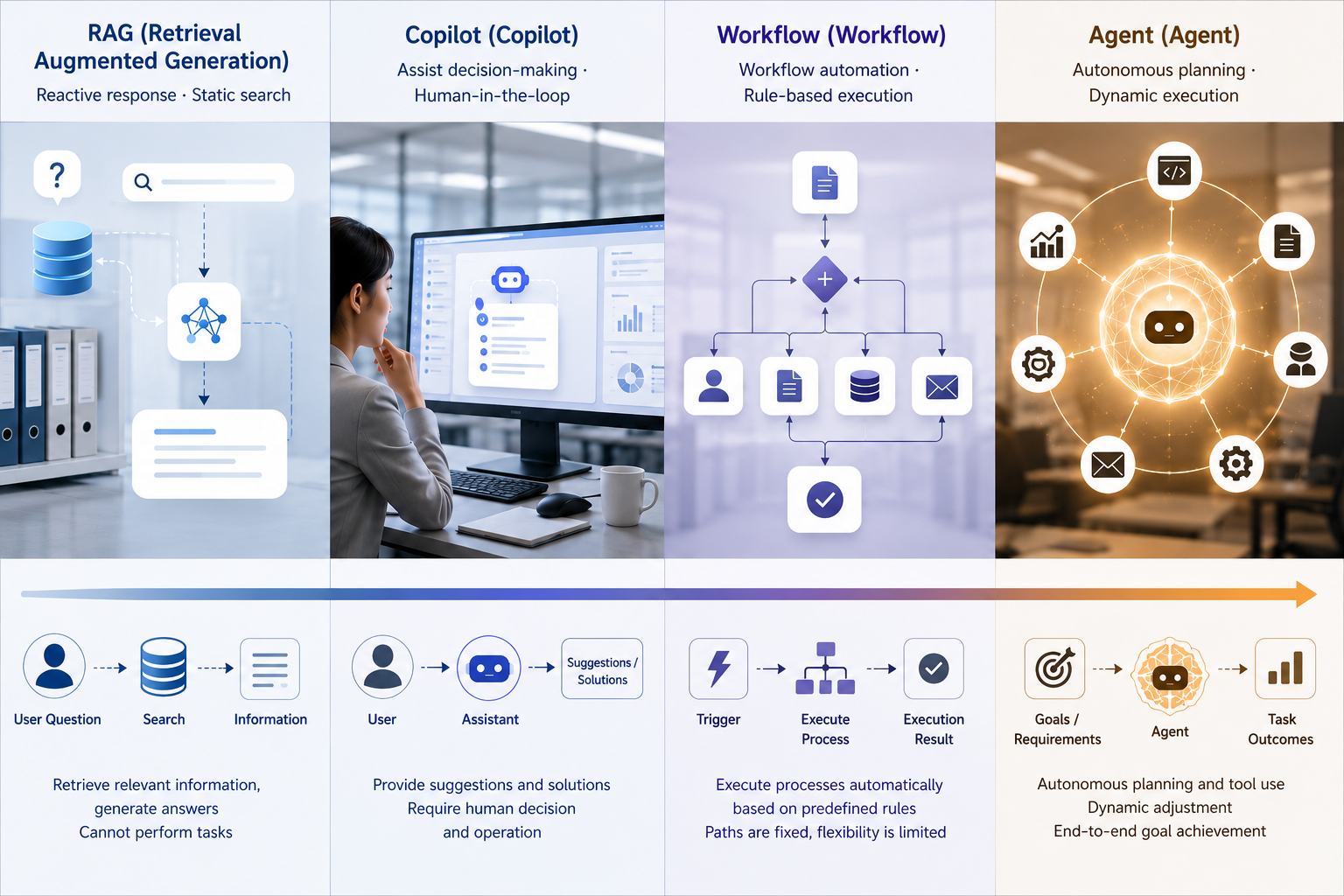
Figure 1-2: Boundaries among RAG, Copilot, Workflow, and Agent. Source: original diagram by the authors. Alt text: Four system types are arranged along decision authority and execution determinism. RAG and Copilot are user-led and low-execution, Workflow follows fixed paths, and Agent dynamically selects actions under a goal. A dashed line shows that mature systems often combine all four.
Figure 1-2 asks teams to inspect responsibility boundaries before naming the system. Mature systems can combine RAG, Copilot, Workflow, and Agent, but the combination must obey decision authority, process determinism, and execution responsibility. Once a component starts advancing a business action for the user, it should be engineered with Agent-level responsibility.
1.3 The Agent Task Closed Loop: Goal, Context, Decision, Action, And Feedback
This section defines Agent through a task loop instead of model capability or product naming. That definition lets later discussions of tools, memory, approval, and evaluation return to the same question: whether the system is truly advancing a task. In plain terms:
An Agent is a system loop that organizes perception, decision-making, action, and feedback around a task goal.
The emphasis is on the loop. An enterprise Agent usually has to handle five objects. Table 1-1 turns them into five questions that can later map to Runtime, Planner, tool invocation, and Trace.
Table 1-1: Five elements of the Agent task loop and the questions they answer. Source: compiled by the authors.
| Element | Question It Answers |
|---|---|
| Goal | What task needs to be completed, and is answering a question enough? |
| Context | What data, rules, documents, and identity information are needed for this task? |
| Decision | Given the current state, what action is most appropriate next? |
| Action | Which tool should be called, and what result or side effect will it produce? |
| Feedback | Does the tool result change the next decision? |
If any part is missing, the system falls back to a weaker form. Without a goal, it becomes generic conversation. Without context, it makes plausible judgments on wrong information. Without decision, it can only write text. Without action, it stays at the suggestion layer. Without feedback, it cannot correct itself or converge. Many products that look like Agents are closer to advanced Copilots: they have conversation, tools, and output, but the task does not form a loop. In enterprise settings, the loop also creates responsibility questions: who allowed the system to act this way, what information it used, when it must stop, and how errors are detected, reviewed, and corrected. These issues cannot be absorbed by one application alone; they eventually return to the platform layer.
1.3.1 Why The Agent Concept Spread So Quickly
The rapid spread of the word "Agent" comes from academic definitions and several forces arriving together. Model capability changed first. Earlier enterprise AI systems were good at classification, prediction, retrieval, and local generation, but few organizations allowed them to decide what to do next. Large models raised natural-language understanding, cross-domain knowledge use, and structured output enough for enterprises to see a new possibility: the system could move from answerer to task participant. Tool invocation also matured. Early large-model applications often stayed inside text even when the answer was good. Function Calling, structured output, Code Interpreter, and MCP made models able to do as well as say in a more stable way. That forced enterprises to take execution boundaries seriously.
Enterprise software itself also changed. For more than a decade, modular SaaS dominated: CRM was one system, ERP another, BI another, ticketing another. With large models, users started expressing a clearer expectation: they did not want to switch among systems, but wanted to hand the task to one system. The market heat came quickly, so the word Agent was used to package almost every large-model feature. Whether a system truly enters the Agent category still depends on how much task responsibility it takes on.
1.4 Agent Task Fit, Risk Level, And Value Judgment
Enterprise Agent projects often start with boundaries that are too broad. Once a team has a large model and several tools, it may place every intelligent demand under the Agent umbrella, which increases governance pressure. A more controllable path is to classify enterprise tasks first. Query tasks are about finding accurate information and usually start with retrieval, RAG, semantic layer, or BI. Drafting tasks are about generating editable results quickly and usually fit Copilot or content-generation assistants. Diagnostic tasks combine multiple information sources and narrow the problem step by step, where Agent value begins to appear. Execution tasks call tools, move across systems, and create side effects; they usually require Agent, Workflow, and approval chain together.
Concrete scenarios make the judgment clearer. "Check this customer's complaints from the past three months" is primarily a query task; RAG plus a CRM query covers most of the value. "Draft an operational review from this week's sales data" is primarily a drafting task; Copilot or a low-risk task Agent is enough. "Explain why gross margin in East China is abnormal" needs diagnosis across metrics, orders, inventory, and historical explanations, so it is closer to DataAgent. "Generate a quotation and enter approval" touches business action and must be designed together with Workflow, approval, and audit. This classification avoids over-engineering and also shows which scenarios pull platform capability. Diagnostic and execution tasks tend to need Runtime, Registry, Policy, and Trace repeatedly.
Task fit and risk level are separate concerns. A task may fit Agent structurally but still carry high risk, so it can advance only with strong approval. A task may be low risk but not need Agent at all. Enterprises often mix these two judgments, slowing scenes that should move quickly while pushing risky scenes too aggressively.
Table 1-2: Five risk levels for tasks and corresponding execution controls. Source: compiled by the authors.
| Risk Level | Typical Action | Recommended Control |
|---|---|---|
| Level 0 read-only | Look up material, check metrics, generate summaries | Execute automatically and preserve evidence |
| Level 1 low-risk write | Create drafts, generate to-dos, write temporary data | Execute automatically with undo |
| Level 2 medium-risk action | Update ticket status, generate quote draft, send internal notification | Confirm key checkpoints |
| Level 3 high-risk action | Send customer email, submit financial voucher, modify master data | Approval plus secondary verification |
| Level 4 extremely high risk | Payment, contract signing, delete high-risk data | Forbid automatic execution by default |
The controlled approach is to first ask whether the task structure fits Agent, then ask how autonomous the Agent may be if it does fit. This book separates Agent definition, platform boundary, and AI-native systems into three chapters for this reason: task fit, governance constraint, and system form belong to different layers.
1.5 Enterprise Agent Difficulty: Boundaries, Responsibility, And Organizational Language
Consumer Agents are attractive because they appear able to do anything. Enterprise Agents are difficult because they must know where to stop. Once placed in an enterprise environment, an Agent faces organizational, permission, process, and responsibility boundaries. As a result, enterprise Agent failures usually do not start with whether the model can answer. They usually appear in five forms.
Table 1-3: Five failure types in enterprise Agents and common root causes. Source: compiled by the authors.
| Failure Type | Symptom | Common Root Cause |
|---|---|---|
| Understanding failure | User constraints are ignored and the goal drifts | Ambiguous expression, insufficient context |
| Planning failure | Wrong tool, wrong action order, or overly long path | Poor tool descriptions, rough decision strategy |
| Execution failure | Invalid parameters, tool timeout, permission denial | Weak schema, insufficient retry and recovery |
| Governance failure | Privilege overreach, missing approval, no trace, no replay | Missing platform policy |
| Product failure | Users distrust results, do not know how to use them, or cannot take over | Weak frontend and evidence design |
This failure taxonomy prevents teams from blaming every problem on the model. Many enterprise projects react to errors by changing the model or continuing to tune the prompt. The problem may instead come from tool contracts, permissions, semantic layer, or approval chain. Classification restores system analysis. In enterprises, failure handling also has an order. Governance failure decides whether the system can go live. Execution failure decides whether it is stable. Understanding and planning failures decide result quality. Product failure decides whether users will keep using it. Enterprise scenarios first ask whether the system is controllable, then whether the experience is impressive.
1.5.1 Limits Of The "Digital Employee" Analogy
Marketing language often calls Agents digital employees, AI colleagues, or virtual specialists. These labels spread easily, but they are risky in engineering. Once an Agent is imagined as an employee, teams tend to expect human-like context understanding, responsibility, discretion, and automatic context completion. Real systems do not possess these abilities by default. They generate the next action from the context, tools, strategy, and model capability they are given.
A more accurate description is that an Agent is a system component in a task chain. It takes on part of perception, decision-making, and execution. It can increase human leverage, while the enterprise responsibility chain still belongs to the organization, process, and surrounding systems. If the team treats the Agent as an employee, the discussion slides toward whether it is smart enough. If the team treats it as a task execution system, the discussion returns to where it is reliable. Enterprise teams need the second question.
1.5.2 From Business Language To System Language
The people who propose Agent requirements in enterprises are often business leaders, product managers, operations teams, or functional departments, not engineers. They do not say, "I need a task execution system with Runtime, Tool Registry, and Policy." They say, "I want the system to analyze anomalies automatically," "I want it to follow up with customers like an assistant," or "I want it to prepare monthly closing materials first." These are real needs, but they are not yet system requirements. Agent platform engineers must translate business language into system language.
That translation looks like requirement clarification, but it often decides whether the project can land. When the business says "analyze anomalies automatically," the system must ask what defines an anomaly, what data sources are authoritative, and what diagnostic steps are allowed. When the business says "follow up with customers like an assistant," the system must distinguish reminders, internal to-dos, customer contact, and approval responsibility. When the business says "prepare monthly closing materials," the system must distinguish data that must be accurate, drafts that can be edited, and conclusions that require audit. When the business says "understand the policy and tell me what to do," the system must confirm whether the policy source is authoritative, whether citations are required, and whether the answer can trigger concrete action.
Many failed projects do not fail because the model lacks capability. They fail because the requirement was never decomposed into goal, context, tools, risk, and acceptance criteria. A quotation assistant illustrates the problem. "Give me a competitive price" is natural business language, but at the system layer it needs at least five questions: competitive against similar historical customers or against current inventory pressure; what customer tier and sales discount cap apply; whether regional price limits, campaign rules, or temporary bans exist; whether the system creates a suggestion, a draft, or a direct quotation; and what threshold requires approval. Only after this translation can an Agent move from understanding human language to acting reliably inside enterprise boundaries.
1.6 From Pilot To Production: Lifecycle, Task Composition, And Operational Thresholds
Many enterprises design early Agents around one interaction: the user enters a sentence and the system returns a result. That view works for demos, but it is not enough for enterprise Agents. Valuable enterprise tasks are rarely one-off Q&A; they are continuing processes. After a business-analysis Agent answers why gross profit declined, the work continues into meetings, action items, owners, and weekly review. After a quotation Agent generates a draft, the work continues into approval, customer communication, contract signing, and fulfillment tracking. After a customer-service quality Agent finds an anomaly, the work continues into staff training, knowledge-base revision, and service-strategy adjustment.
Once an Agent enters an enterprise, it shifts from one-time execution to long-running operation. Task state must be saved: where the task started, what steps it took, where humans confirmed, and what is still waiting. Task results must be consumable downstream: action items may enter project management or meeting systems, quotation drafts may enter approval, and ticket anomalies may enter finance review. If an Agent's output remains only in chat logs, it is hard to make it part of enterprise work. Task experience must also accumulate. Every user edit, rejection, confirmation, and feedback item is a basis for system improvement. An enterprise Agent is not finished after deployment; it becomes closer to real work through continuous feedback and iteration.
1.6.1 Five Thresholds From Pilot To Production
Many Agent projects are not blocked during pilot. They fail because they enter production too soon after a successful pilot. Moving from pilot to production requires at least five thresholds.
Table 1-4: Five thresholds from pilot to production and their different states in two phases. Source: compiled by the authors.
| Threshold | Typical Pilot State | Required Production State |
|---|---|---|
| Task stability | A few cases run through | Boundary samples and exceptional scenarios are covered |
| Context credibility | Temporary material stitching | Authoritative sources, versions, and definitions |
| Boundary control | Manual verbal agreement | Explicit risk grading and approval |
| Result reviewability | Only final answer is checked | Evidence, process, and trace |
| Operating mechanism | Temporary project-team maintenance | Continuous feedback, evaluation, and version governance |
These five thresholds belong to the Agent system itself. Agent value comes from execution; once execution begins, stability, credibility, boundary control, reviewability, and operations must keep up. Another often missed threshold is whether the business accepts partial automation. Many pilots try to finish the whole task in one pass during demos. Production systems need to split actions into categories: automatically executable, confirmation required, approval required, and forbidden by default. A quotation assistant can automatically organize historical cases, generate discount suggestions, and write a quote into a draft area. Actions above discount thresholds, customer-facing email, and formal approval submission should be handled by humans or existing processes. This looks less automatic, but it protects long-term operation.
Before go-live, the most important preparation is not a longer prompt. The team needs a task responsibility table: where inputs come from, what tools can do, which steps change business state, which results are suggestions, and which exceptions must stop the run. Engineering teams use it to design tool permissions and Runtime. Business teams use it to confirm process responsibility. Security and internal control use it to judge approval requirements. Without this table, a system may run in demo but still fail to enter production.
The table also exposes a reality: the same task name can have different boundaries in different organizations. Headquarters quotation, regional quotation, and channel quotation may use different discount authority. Internal business review and external customer email require different approval. Agent design cannot rely on task name alone; it must know which business process the Agent enters. Once an enterprise faces these thresholds seriously, it can no longer build only an isolated Agent. It enters the platform problem. That is the starting point of Chapter 2.
1.7 Boundary Review Method For Enterprise Agents
Boundary review should happen before prototyping, not after the demo. Once a prototype has tools, data, and an interface connected, teams tend to follow the feeling that the system already works and become reluctant to reopen responsibility questions. A steadier approach is to describe each candidate Agent requirement as a task chain first: what goal the user states, what data the system reads, which tools it may call, whether each step changes business state, where human confirmation is required, and who will consume the final artifact. If the chain cannot be written down, the project is still an idea and should not be promised as a production capability.
The review can start with three inputs. The first is the task goal, written as an acceptable business outcome instead of a desire for a smarter system. "Explain the gross-margin anomaly in East China" is reviewable because it leads to questions about metric definition, data scope, anomaly criteria, and output format. "Build an operational analysis assistant" is too broad. The second input is the execution boundary: which actions are allowed and which are forbidden by default. Looking up metrics, summarizing historical cases, generating drafts, writing to an approval draft area, contacting customers, and submitting formal documents carry different risk controls. The third input is the evidence requirement: which citations, Trace records, tool responses, and human confirmations must be preserved. An Agent without evidence requirements may feel useful in the short term, but it will be hard to defend during incident review.
The review also needs a downgrade decision. Not every candidate requirement should become an Agent. If the task is mainly knowledge lookup, RAG with citations and permission filtering may be the better form. If the task is mainly writing or organizing material, a Copilot is often easier for users to control. If the process path is stable, Workflow usually provides better determinism and auditability. Agent is suitable when the path changes with intermediate results, the work advances across systems, and the system must continue making judgments during execution. Turning a simple lookup task into an Agent adds runtime, approval, and evaluation burden. Disguising high-risk execution as a Copilot misses tool permission, human confirmation, and failure recovery.
The review should produce three artifacts. The first is a task responsibility table that records the goal, roles, tools, data, risk level, and human checkpoints. The second is a runtime evidence requirement that states which inputs, outputs, tool calls, policy hits, and human operations must appear in Trace. The third is an admission decision: whether the current requirement fits RAG, Copilot, Workflow, Agent, or only an exploratory prototype. This is slower than saying "build an intelligent assistant," but it reduces rework later. Enterprise Agent reliability is not patched in by operations after launch. It starts when responsibility is written into the system design.
1.8 From Concept Boundaries To Platform Responsibility
This chapter discusses Agent boundaries to make new enterprise-system responsibilities explicit, not to freeze one industry definition. Once a system moves from answering questions to decomposing tasks, calling tools, and advancing state, it is no longer only a model application. The platform must answer who authorized the execution, which actions were taken, what evidence was used, how failure is recovered, and who reviews the result. Readers will see this boundary repeatedly in later chapters. Chapter 22's Runtime turns a task into a manageable Run. Chapter 23's Tool Registry makes actions registerable and auditable. Chapter 30's HITL stops high-risk actions for human judgment. Chapter 38's Trace makes the process replayable. Without these platform responsibilities, an Agent can remain a demo system: it can generate a plausible answer, but it cannot become an enterprise production system.
When judging whether a scenario fits Agent, model understanding is only the starting point. Teams must also examine whether the task advances across steps, whether it touches enterprise data and tools, and whether it needs an evidence chain and responsibility chain. This judgment directly affects how the rest of the book should be read: the opening chapters establish the platform view, and later chapters add models, data, tools, runtime, evaluation, security, and organizational governance.
1.9 Reader Expectations And Chapter Thread
The boundary judgment in this chapter runs through the rest of the book. An Agent should not be read as a smarter chat interface. It is a runtime system that enters an enterprise task chain. Once a system decomposes goals, selects tools, reads data, writes state, or produces deliverables, the platform must manage authorization, execution, evidence, and rollback. Later chapters on models, knowledge bases, tools, Runtime, DataAgent, Trace, security, and organizational governance return to the same question: which business state changed, who authorized the change, and what evidence remains.
Readers can follow three threads. The first is the execution thread: how natural language becomes a task plan, how Runtime manages intermediate state, how tools are registered and authorized, and how HITL handles high-risk actions. The second is the evidence thread: how RAG citations, semantic-layer definitions, tool responses, Trace, Eval, and human confirmation combine into a reviewable result. The third is the governance thread: how cost, SLO, security, compliance, ownership, and case admission constrain the pace of Agent expansion. These threads decide whether an Agent can move from demo to production.
Beginners often treat Agent difficulty as a model-capability problem. Model quality matters, but enterprise delivery often fails outside the model: context sources are unstable, tool contracts are vague, permissions are not carried through, approval state cannot recover, Trace cannot replay, and failure samples never enter evaluation. Making this explicit helps readers place later technical modules correctly. Chapter 8's structured output is an execution contract before tool invocation. Chapter 23's Tool Registry is an entry point for permission, schema, and audit. Chapter 38's Trace is the base for incident diagnosis and evaluation replay.
The first platform version does not need to cover every scenario. A better starting point is one task chain with clear boundaries, strong evidence, and limited tool side effects. The team should write the goal, data, tools, human checkpoints, and rollback conditions as reviewable material, then run that chain reliably before expanding to more domains. With this framing, the architecture in later chapters reads less like a large one-time program and more like a set of capabilities that enterprise Agents need as they enter production work.
1.10 Boundary Review Samples and Reader Self-Check
Readers can use a few samples to test the boundary in this chapter. The first sample is knowledge Q&A: a user asks about a policy clause, the system retrieves documents, cites sources, and takes no external action. This is closer to RAG. The second sample is writing assistance: a user asks for meeting notes or an email draft, the system returns editable text, and a person decides whether to send it. This is closer to Copilot. The third sample is a fixed approval flow: a user submits reimbursement material, and the system validates, routes, and archives it by deterministic rules. This is closer to Workflow. The fourth sample is business-anomaly analysis: the system clarifies metrics, queries data, analyzes causes, generates charts, waits for owner confirmation, and carries the result into the next review. This is closer to Agent.
The samples help teams put requirements into the right form. If every sample is called an Agent, simple tasks get unnecessary runtime burden and high-risk tasks miss approval and Trace. Boundary review does not limit innovation. It makes each system form carry the right responsibility. RAG should handle evidence and permission. Copilot should support editing and takeover. Workflow should provide determinism and audit. Agent should handle state, tools, recovery, and responsibility chain.
For self-check, readers can ask five questions. Will the system change business state? Does it need to remember intermediate results across steps? Will tool outputs change the next action? Does it need recovery or human handoff when exceptions occur? Does it need to prove who authorized each action and what evidence was used? If most answers are no, the project may not need the Agent form yet. If most answers are yes, platform capabilities should be introduced early instead of pushing all responsibility into the prompt.
This self-check affects later reading. A project classified as RAG should prioritize Chapters 19 to 21 and Chapter 40. A tool-enhanced Copilot should prioritize Chapters 8, 23, and 47. A long-running Agent should read Runtime, Planner, Memory, HITL, Trace, and security chapters. Chapter 1 gives the entry judgment; later chapters turn those judgments into engineering implementation.
1.11 How Boundary Judgment Constrains Later Chapters
The boundary judgment in this chapter constrains how later chapters should be read. In the model chapters, readers should ask whether inference services can support task execution, not answer quality alone. In the tool chapters, they should ask whether tool calls change business state and whether those changes leave evidence. In the Memory, Planner, and Runtime chapters, they should ask whether the system makes decisions across steps and whether permission, budget, and approval limit those decisions. In the DataAgent, observability, evaluation, and security chapters, they should ask whether Agent actions can be reviewed, assessed, and recovered. Agent is not the name of a single component. It is an operating form created by several platform capabilities working together.
This constraint helps readers avoid two common misreadings. The first is treating every dialogue experience as an Agent, which introduces Planner, Memory, and multi-tool orchestration before the task needs them. The result is higher cost and risk. The second is treating Agent as model inference only, which ignores tool permissions, approval, Trace, Eval, and security gates. The system may demo well but cannot carry real business responsibility after launch. This book takes a platform view because enterprise problems rarely stay inside a single model or a single application. Whether a task should become agentic depends on decision ownership, action side effects, failure recovery, evidence retention, and organizational responsibility.
Chapter 1 therefore provides an entry point for engineering judgment. In every later chapter, readers can return to the same questions: Does this capability make the system better at executing tasks? Does it create a new responsibility boundary? Does platform governance need to absorb that boundary? When the answers are clear, expansion has a purpose. When the answers are vague, the team should strengthen boundaries, evidence, and recovery before adding more Agent capabilities.
1.12 Team Alignment On Terminology Boundaries
Terms such as Agent, Copilot, Workflow, and RAG are easily used differently across an enterprise. Product teams may call any dialogue entry an Agent. Model teams may call tool use an Agent. Business teams may call automation an Agent. Security teams care whether the system creates side effects. When terminology is not aligned, review meetings become concept debates and delay decisions about permission, evidence, and recovery.
Teams can align through task samples. Instead of first debating whether a system is an Agent, decompose the task: what goal the user gives, which context the system reads, whether it calls tools, whether it changes business state, whether human confirmation is required, and how failure is recovered. Once the sample is clear, the system form becomes visible. Terminology then serves engineering judgment instead of forcing engineering judgment into labels.
Later chapters follow this pattern. Each capability is tied to a task-chain segment, a responsibility, and an evidence trail. Readers using this book inside their own teams can first calibrate with the boundary samples in Chapter 1, then move to technical selection. Shared terms reduce wasted debate during platform construction.
1.13 Acceptance evidence for boundary judgment
Agent boundary judgment needs acceptance evidence. A team should show more than a claim that a system is an Agent. It should show goal, context, decision, action, feedback, and responsibility records. If the system only answers questions and has no auditable action, it belongs closer to RAG or Copilot. If it can call tools but lacks approval, rollback, and Trace, it has not reached the enterprise production boundary.
Review can sample several real task chains and check how user intent becomes a plan, how tool calls are authorized, how failure recovers, how humans confirm, and how the final artifact enters downstream work. This evidence turns conceptual boundaries into engineering judgment and gives later platform chapters a shared vocabulary.
1.14 Boundary review ledger and follow-up tracking
Boundary review should not remain a one-time meeting conclusion. In an enterprise, the same Agent requirement moves through prototype, canary, launch, expansion, and retirement. Its boundary can move as tools are added, data scope expands, or the user group changes. The classification in this chapter, RAG, Copilot, Workflow, or Agent, should enter a lightweight ledger that records why a requirement was placed in one form, which evidence supported that judgment, and which condition should trigger review again. The ledger can stay simple: task goal, user role, system action, data source, tool side effect, human checkpoint, evidence requirement, current system form, and next review date.
The ledger prevents a common drift. A capability classified as Copilot during prototype can gradually connect to tools, approvals, and automatic writes without returning to Agent review. A contract-summary assistant may begin as an editable draft generator. Months later it connects to the contract repository, risk-clause library, and approval-draft tool. At that point it affects legal workflow. If the team still manages it as a Copilot, it will lack Tool Registry, HITL, Trace, and permission review. Ledger triggers can catch this movement: new write actions, sensitive data access, output entering a formal process, broader user scope, and higher automation all require boundary review.
The ledger should also retain rejected and downgraded requirements. A requirement may avoid the Agent form because its path is stable and fits Workflow. Another may stay as RAG or Copilot because evidence is not ready. Keeping those conclusions helps the team avoid repeated terminology debates when the same idea returns. Downgraded requirements also point to platform gaps. Missing Trace suggests runtime evidence work. Missing permission models suggest policy work. Missing evaluation samples suggest quality gates. Boundary review then becomes a maturity signal for the platform, not an innovation blocker.
The ledger connects this chapter to later engineering chapters. Chapter 22 Runtime can use task form to decide state-machine depth. Chapter 23 Registry can use risk level for tool admission. Chapter 30 HITL can use human checkpoints to define approval semantics. Chapter 38 Trace can use evidence requirements to set recording detail. Chapters 50 and 51 can use data and action boundaries to define security samples. Once the conceptual boundary enters a ledger, it becomes engineering input. Readers can reuse the same method in their own projects: record the boundary first, then select the platform capabilities required by that boundary.
1.15 Reviewing counterexamples for boundary judgment
Counterexamples are often more useful than definitions when judging Agent boundaries. Many projects fail because teams package ordinary automation, retrieval Q&A, or workflow orchestration as Agents without adding action responsibility, state recovery, and audit evidence. The demo looks smooth, but production exposes gaps around write actions, approval, permissions, and exception paths. Chapter 1 should make this clear: a conversational interface or a model call does not make a system an Agent.
Counterexample review can start from task consequences. A system that retrieves policy and writes a summary is usually knowledge Q&A. A system that routes approval through fixed rules is usually Workflow. A system that explains next-step suggestions without executing them may be a Copilot. A system that selects tools, initiates actions, handles failure, and preserves evidence enters the Agent boundary. If a system changes business state without Runtime, Policy, HITL, and Trace, the boundary design is incomplete.
Counterexamples also help teams narrow scope. Early projects can stay at Copilot or Workflow shape without forcing an Agent label. For high-risk tasks with weak evidence or unclear responsibility, the system can first produce suggestions and drafts, then execute after human confirmation. After tool contracts, permissions, evaluation, and recovery paths stabilize, automation can expand. This cadence reduces pilot failure and gives platform construction a clearer sequence.
A first version can require every Agent proposal to include a counterexample note: why it is not ordinary RAG, why fixed Workflow is insufficient, which actions require model-mediated decisions, and which actions need human confirmation. This note forces boundary clarity and prepares the entry point for later chapters on Runtime, Tool Registry, HITL, and Trace.
1.16 Counterexample review for Agent boundaries
One useful way to understand Agent boundaries is to review counterexamples. Many teams treat a smooth demo as proof of capability: the user asks a question, the model calls a tool, and the page returns a result. Production problems usually appear in areas the demo did not cover. Did the model make an irreversible decision for the user? Did the tool create side effects? Did the answer carry evidence? Who recovers after failure? These questions determine whether the system belongs in an enterprise process.
Counterexample review can start with three sample types. The first is "completed but unclear responsibility," such as an Agent sending a report without confirming recipient and permission. The second is "correct answer with weak evidence," such as a compliance recommendation that cannot cite the policy version. The third is "smooth flow without audit," such as a successful tool call whose Trace lacks parameters, approval, and output artifact. Each sample clarifies the boundary between Agent, Copilot, Workflow, and RAG.
A first platform version can include these counterexamples in admission material. Before a new Agent launches, the team answers whether it acts for the user, whether the action has side effects, whether evidence is traceable, whether failure can recover, and whether ownership is clear. If these questions cannot be answered, the capability should remain an assistant or workflow enhancement. Runtime, tools, Memory, HITL, Trace, and Guardrails then all connect back to the same boundary.
1.17 Operating evidence for Agent boundaries
After Agent boundary management reaches production, a successful demo is not enough evidence. The platform needs stable fields for decision actor, tool side effect, approval point, execution receipt, and audit record, and those fields should connect to release records, Trace, evaluation samples, and incident notes. When a production issue appears, teams can follow one set of facts to understand scope, ownership, and repair order instead of stitching together model logs, business logs, and verbal explanations.
This evidence also connects the surrounding chapters. It links to Chapter 22 on Runtime, Chapter 30 on HITL, and Chapter 50 on security: upstream capabilities provide assumptions, downstream capabilities consume the result, and governance capabilities preserve evidence and review decisions. If these materials do not share identifiers and versions, the production system splits apart. Business owners see user complaints, platform owners see system errors, and security or compliance teams see explanations written after the fact. That separation makes it hard to decide whether the issue came from data, model behavior, tool contracts, workflow state, or organizational ownership.
Common production risks include demo tasks appearing complete while production cannot prove who made the decision or approved the side effect. These risks are less visible during demos because demos usually exercise the successful path. Production users bring boundary cases, repeated requests, permission changes, and long-running state. The platform team should turn such failures into release samples. Some samples should block launch, some can be handled by degradation, and some require the business owner to accept the remaining risk with a review date.
Agent boundaries should be confirmed through operating evidence so readers can separate interaction design from responsibility transfer. The record can stay compact, but it should include time, version, owner, sample, action, and the next review condition. Without those fields, review remains informal experience. With them, one production issue can become material for later releases, evaluation suites, and training.
A first platform version can start with a small set of high-risk paths. Choose flows with high traffic, high business impact, or sensitive data, require an evidence package for each change, and then expand the practice to ordinary scenarios. This keeps the capability at the engineering level: runnable, explainable, and recoverable.
Chapter Recap
Agent is not a general name for large-model applications. It is a system that organizes perception, decision-making, action, and feedback around a task goal. RAG, Copilot, Workflow, and Agent each have boundaries, and many enterprise project failures that look like weak model capability start with wrong requirement classification. The challenge of enterprise Agents is not to make the system more human-like, but to make it know which actions can be automatic, which need confirmation, and which must leave evidence. This book starts from the platform because once a system can advance enterprise tasks, the problem enters runtime, permission, audit, and governance layers instead of staying at the model layer. The next chapter continues with platform boundaries: enterprises are building shared infrastructure for many Agents, not isolated Agents. Applications, frameworks, and low-code tools can all participate, but the platform still carries model access, tool governance, runtime state, evaluation, safety, and audit responsibility.
References
Yao, S. et al. (2023). ReAct: Synergizing Reasoning and Acting in Language Models. ICLR.
Schick, T. et al. (2023). Toolformer: Language Models Can Teach Themselves to Use Tools. NeurIPS.
Russell, S. & Norvig, P. (2020). Artificial Intelligence: A Modern Approach. Pearson.
OpenAI. (n.d.). Function calling guide.